Search for:
David Barnes

David Barnes

I have lived in Greater Manchester since 1989, having moved north deliberately in search of the landscapes I saw on so many early 1960s films (especially the views from the moors). I have not been disappointed, it is a great place to work, rest and play, as they say.

The Bridgewater Canal and its environs in the city of Salford in particular offer many places that illustrate the heritage, the arts and the wonderful greenscape.

I want to help people explore these areas so we can all learn and create together a new experience of a unique area in the world and can offer a range of guided walks to do this. If you would like to discuss with me your specific requirements then please do get in touch.

David Barnes
David Barnes

David Barnes
07961 535163

davidbarnes.david@gmail.com

Chat Moss, the Bridgewater Canal and the Industrial Revolution

Chat Moss has an almost mythical character yet is very much a living landscape. Its mythical roots come from its origins 10,000 years ago during the Ice Age. Daniel Defoe’s description of the area as frightful in 1724 during his tour of Britain contributed to this sense of a land beyond civilisation. He could not imagine what nature meant by the production of such a waste land.

The Manchester to Liverpool railway line crossed Chat Moss in the early 19th century, commencing the Railway Mania. The northern border of the Moss is marked by the Bridgewater Canal which ushered in the age of Canal Mania years before the Railways took over.

If you open John Aikin’s Description of the country for Thirty to Forty Miles around Manchester (1795) you very quickly encounter a map of the northwest of England and a striking feature of that map is the number of canals on that map. The engineering wonders that were created with the canals generated fantastic images that Aikin evokes as,

the extraordinary sight, never before beheld in this country, of one vessel, sailing over the top of another; and those who had at first ridiculed the attempt, as equivalent to building a castle in the air, were obliged to join in admiration of the wonderful abilities of the engineer (p.114).

This was at Barton upon Irwell where James Brindley built the first aqueduct for the Bridgewater Canal across the River Irwell, on the eastern edge of Chat Moss. It enabled Brindley to plot a better route to Runcorn and the Mersey avoiding the original idea of taking the canal across Chat Moss.

Northwest England has a significant landscape heritage of peat bogs and Chat Moss is a key recovering element of that landscape. Little Woolden Moss is part of Chat Moss; it is now owned and is being restored by the Lancashire Wildlife Trust. If you look north across Little Woolden Moss on a clear day you can see an apparently uninterrupted greenscape leading up Winter Hill part of the West Pennines. Chat Moss is a lowland peat moss and much of the West Pennines is upland peat moss.

These mosslands began to form about 10,000 years ago during the last ice age when peat began to be laid down on marine, estuarine or fluvial deposits adjacent to estuaries, on river floodplains, or on the site of shallow glacial lakes. These wet, waterlogged areas were originally colonised by reeds and rushes. When this plant material died it could not be fully broken down and this led to the formation of fen peat. Then bog mosses (Sphagnum mosses) began to colonise and changed the underlying peat from fen to bog peat. As the peat accumulated, the surface of the bog was elevated above the surrounding land, forming a dome, hence often these are known as raised bogs.

Chat Moss has a rich industrial heritage also, it was used historically as a waste disposal site for Manchester. The waste was a mixture of organic and mineral wastes, ranging from manures to steelworks waste. Chat Moss was purchased by the Manchester Corporation in 1895 for use as a waste disposal site to alleviate growing waste generation by the city population, but also to reclaim the peat for agricultural purposes. During drainage, the waste from Manchester was incorporated into the moss to reduce loss of soil volume as the peat dried out. The earliest waste used was nightsoil, which was mainly ashes mixed with the contents of privies.

Since the mid-19th century, the area of lowland raised bog in the UK has fallen by 94% from 95,000 ha to 6,000 ha. Chat Moss has in that period been industrially mined for peat for fuel and as an agricultural and garden product. This extraction of moss only ended on Little Woolden Moss in 2017 but fortunately that area is now being actively restored as a peat moss by the wildlife trust.

If you are interested in learning more about Chat Moss then contact Bridgewater Green Badge Guide – David Barnes Tel: 07961 535163   email:davidbarnes.david@gmail.com

Bollards!

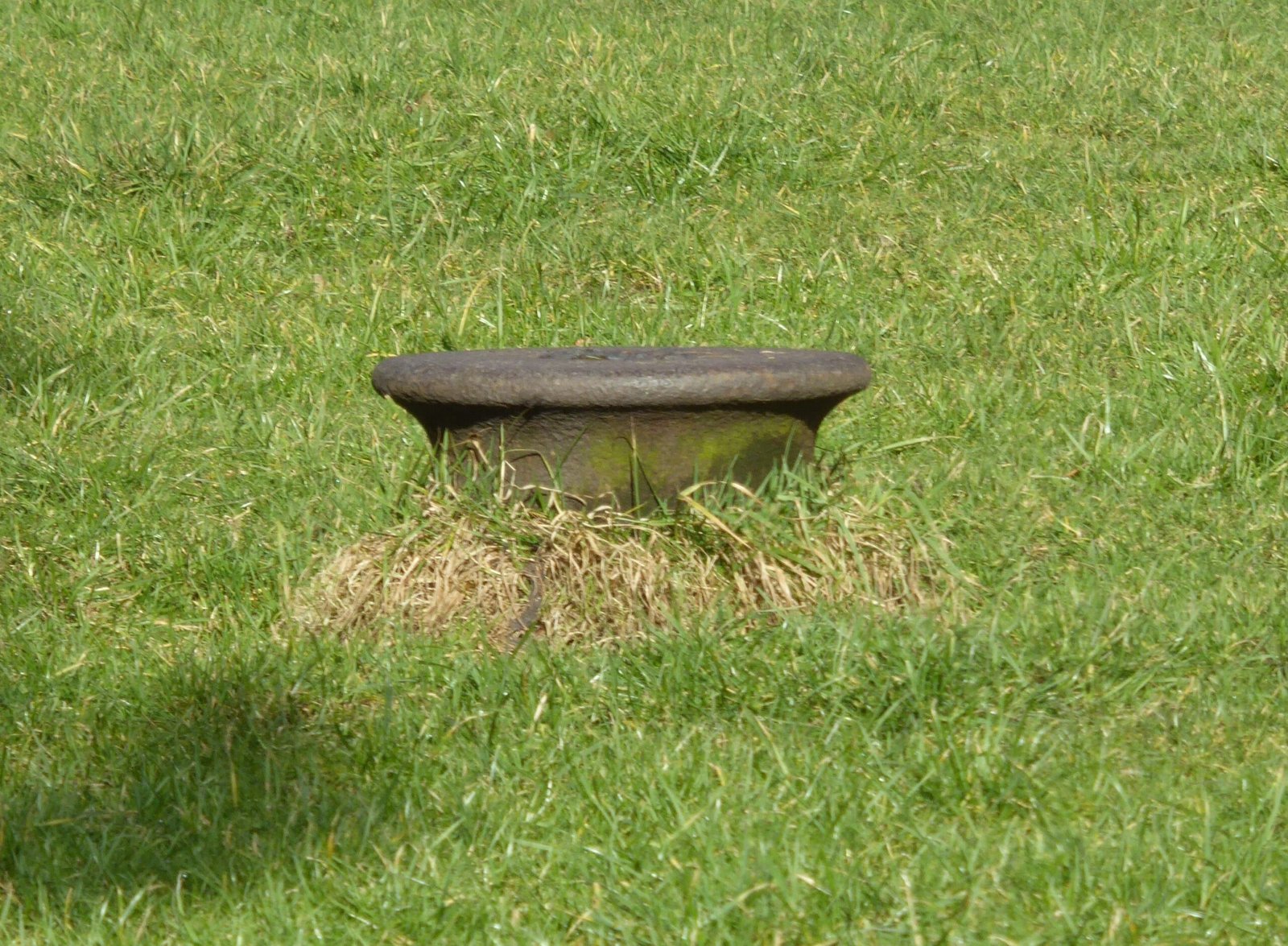
On Worsley Green there is an iron bollard sat on its own and looking very out of place.

Worsley Yard Iron Bollard

Have you ever wondered why it is there?

What is a bollard?

A bollard is a sturdy, short, vertical post and originally described a post on a ship or wharf used principally for using ropes to secure boats.

The word is probably related to bole, referring to a tree trunk.

From the 17th and 18th centuries, old cannon were often buried muzzle first to be used as bollards on quaysides.

From the 19th century bollards were purpose-made, but often inherited a similar “cannon” shape.

What about our bollard?

Worsley Green used to be a busy industrial yard dating from the opening of the Bridgewater Canal in 1761. The yard built up around the Delph area to service the mines and canal at Worsley. It was not until the early 20th century that the yard was turned into the green that we know today. Our bollard is one of the last remnants of Worsley Yard.

Railways

An Ordnance Survey (OS) map from 1848 shows a mineral railway from Sanderson Pit (colliery), just east of Roe Green to the coal staithe on the canal at Worsley. At the time the coal wagons were moved by gravity and horses.

In 1864 the Eccles, Tyldesley & Wigan Railway opened which ran through Worsley Woods between Monton Green and Roe Green. It was connected to the mineral railway at Sanderson’s Siding. This led to the first steam locomotive being delivered to Worsley Yard in 1870 to replace horsepower and a branch line with an engine shed was built.

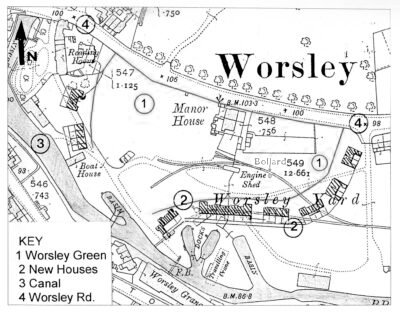
The OS map from around 1900 shows the area of the yard and the railway with location of new houses and green superimposed:

The bollard is opposite house No.146 and is shown on the map next to the railway that crossed the yard.  It was close to the engine shed and was possibly used to tie up locomotive or wagons.

In 1905 the yard was cleared of almost all evidence of its industrial past and the houses we see today were built around what we now know as Worsley green.  All that remains is the base of the yard chimney which became the Duke of Bridgewater memorial, the sluice for the culverted Worsley Brook, the ‘ghosts’ of the railway sleepers…And of course, our own ‘Worsley Yard Iron Bollard’ which is now over 150 years old and if sentient would have stories to tell.

Map of Worsley Green: From Ordnance Survey map survey of 1889, revised in 1904 and published 1908 (Image copied from Alan Godfrey Maps edition published 2003).

Thanks for additional detail of houses built around the Green and map provided by John Aldred.

Written by Mark Charnley, Bridgewater Canal Green Badge Guide.

Eccles Cakes

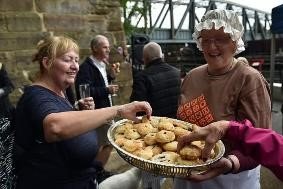
Eccles cakes are a sweet pastry cake filled with dried fruits, usually currants and raisins, sugar, spices and sometimes butter.

The true origins of the cake are not known but the first recorded recipe for something like an Eccles Cake and called “sweet patties” was published by Elizabeth Raffald, housekeeper at Arley Hall, Cheshire in 1769 as part of a book of 800 recipes.  The recipe included boiled calf’s foot as well as dried fruit.

In 1793, James Birch opened a bakery in Eccles and started to sell cakes similar to Elizabeth Raffald’s sweet patties and they quickly became known as Eccles cakes. 

Eccles cakes proved very popular and were exported to Australia, America, the West Indies and Spain.  Alcohol was added (usually brandy or rum) as a preservative for exported cakes.

Eccles cakes do not have protected status as that afforded to Stilton cheese or Melton Mowbray pork pies, so they are made and sold in many countries across the world.

Few places make Eccles cakes commercially in Eccles now.  The major manufacturer is the Real Lancashire Eccles Cake company which is in Ardwick, Manchester.  A local commercial bakery, Quayside, on the Lyntown industrial estate beside the railway between Eccles and Patricroft stations is the largest producer locally in Eccles.  Two local small bakeries also make their own Eccles cakes: Law’s bakery on Parrin Lane, Winton, Eccles (near Monton church) and Wards Bakery on Barton Lane.

In 2004 and again in 2013, Eccles cakes made national headlines as Greggs bakery stopped selling Eccles cakes in all its shops, claiming there was no market for them, customers preferring chocolate cakes and muffins.  In 2013, during the Eccles Cake Festival, they again refused to stock them, even in their Eccles branch.

Lancashire Fire service have reported that Eccles cakes can catch fire if heated in a microwave oven, possibly due to the sugar content so if you prefer warm Eccles cakes, it is best to reheat them in the oven.

In the 2013 Eccles cake festival there was a competition called the “Great Eccles Cake-off” to find the best amateur bakers including the best Eccles cake.  The winner, a Mrs E Charnley of Eccles, received one dozen Eccles cakes as a prize (!)

So, love them or loathe them, call them dead fly cakes, fly pies, fly cemeteries, sweet patties, eat them hot or cold, from a famous chef recipe or an old favourite, enjoy this fine and tasty treat from Eccles, preferably one of the locally made ones!

Elizabeth Charnley is a Green Badge Guide for the Bridgewater Canal.

Check out her website www.charnleysoutdoors.com to contact her directly.

Worsley Delph

by Alexandra Fairclough

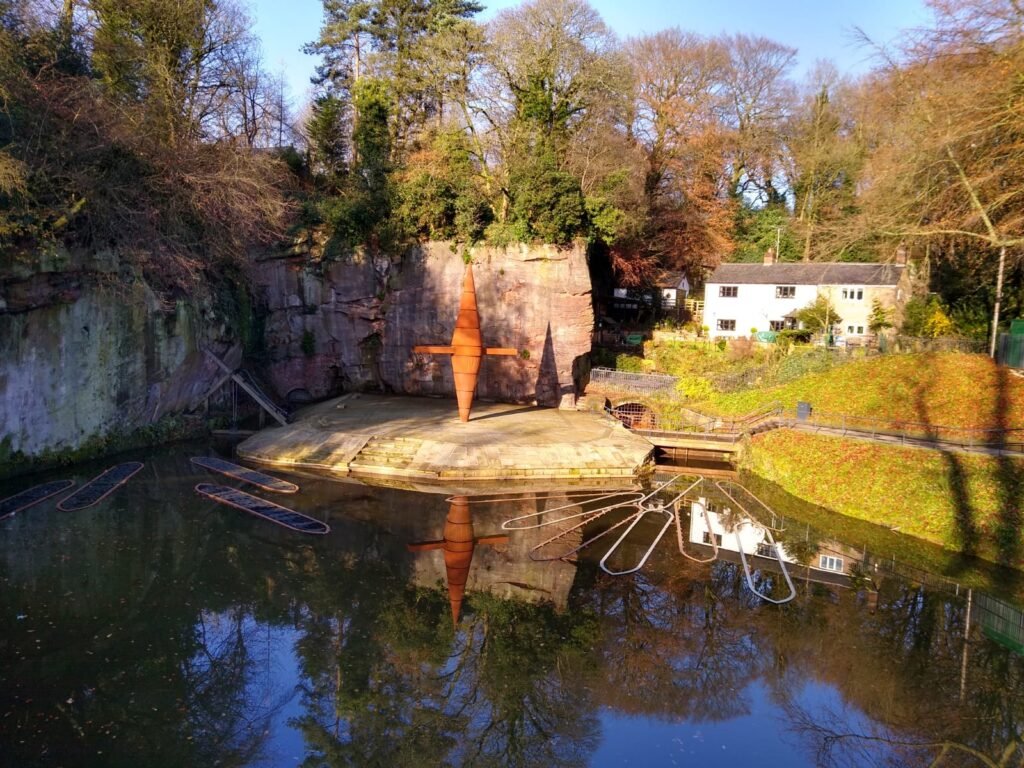
The newly refurbished Delph, Worsley

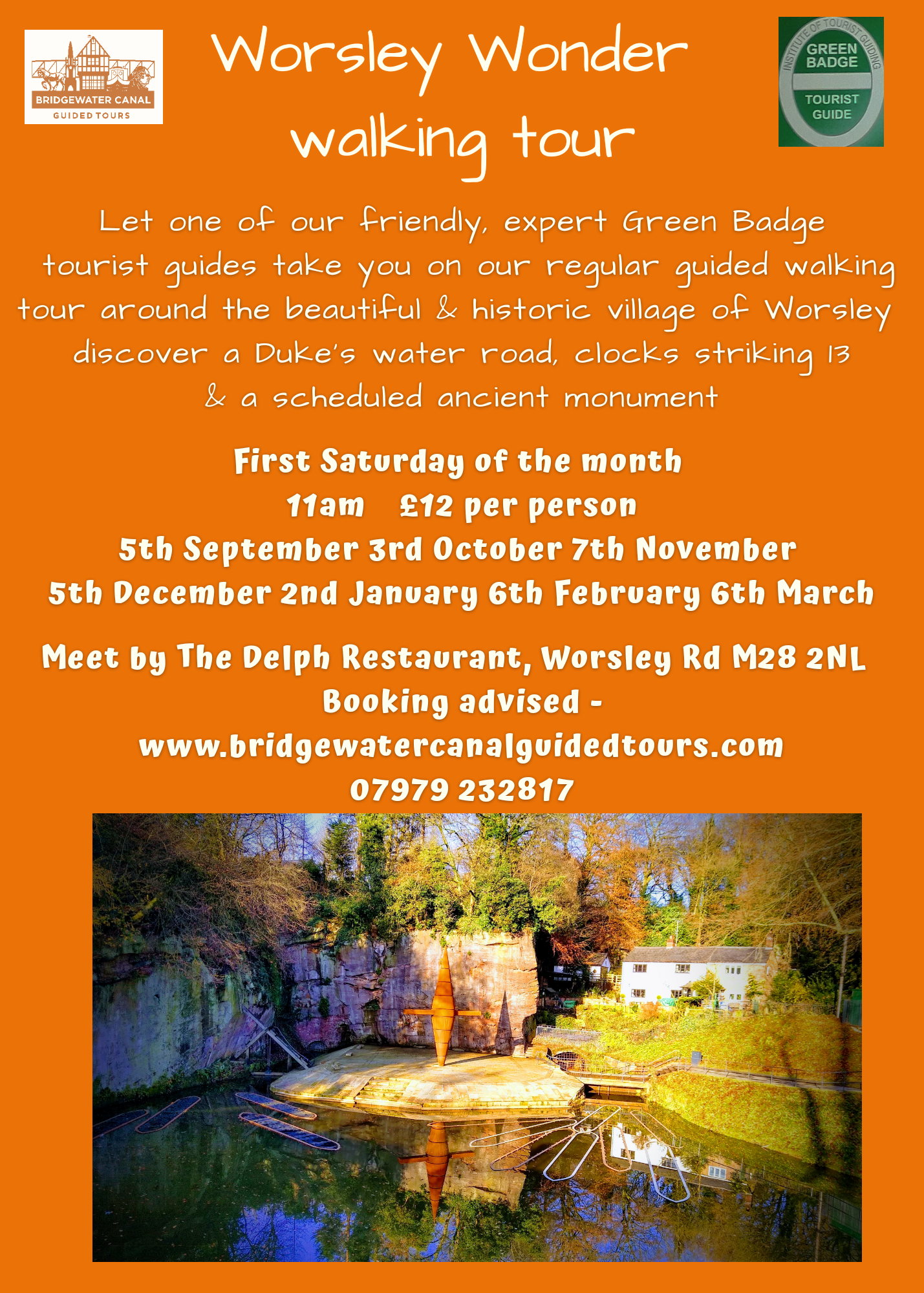
Looking today at the recently refurbished Worsley Delph, we can see a floodlit cross feature set within a distinctive stone-faced water filled hollow. This former stone quarry was used for many of the local buildings but it was the start of the Bridgewater Canal, the cradle of the Industrial Revolution.

Francis Egerton, the third Duke of Bridgewater, wanted to mine his coal deposits out of his land.  Coal had been mined in Lancashire for centuries but the Worsley mines ran deep and kept flooding.  Influenced by his father’s idea to drain the mines, Francis Egerton decided to cut a water course to help reduce flooding, access and retrieve the coal and also transport it to market.

In 1761, the Bridgewater Canal from Worsley Delph to Manchester was completed. Coal from the Worsley colliery canal tunnels and other local pits could get to market quickly and more cheaply than ever before.

The main consumers for this coal initially were households for cooking and heating, however, a constant and much cheaper supply led to demand from industry such as brick-making, metal trades, glass-making and eventually to larger scale manufacturing industries involving imported raw cotton. Due to fact that almost 50% of the world’s raw cotton was manufactured in the 19th century was  traded from Manchester, it became a wealthy city known as ‘Cottonopolis’.

Learn more about the Worsley Delph, the mines, the people who created or visited the canal and the meaning of the public art on one of our Worsley Tours. The Creative Worsley tour also includes the artists musicians architects and writers associated with the first cut canal in England.

Alexandra runs regular tours around the Bridgewater canal.

To contact her visit http://Alexatours.eventbrite.com

Book our next Worsley tour here

Saturday 3rd October 2020

11am Meet outside the Delph Bar & Restaurant

https://worselywonderguidedtour.eventbrite.co.uk

Green Badge logo

What is a Green Badge Guide?

The Green Badge is awarded after passing a detailed course accredited by the Institute of Tourist Guiding.

The Institute of Tourist Guiding was set up in 2002 with the support of the Department of Culture, Media & Sports and Visit Britain and has since been instrumental in raising the profile and status of tourist guiding in the industry nationwide.

This course was made possible due to the support of Salford City Council and the EST.1761 project and National Lottery Heritage Funding.

Our guides have undergone intensive training on the history of the canal, the area, the geology and the people related to the Bridgewater Canal and the industries and culture created by and around it.

Entertaining, knowledgeable and professional, our guides have the history, the stories and the most up to date local information to provide any visitor with an excellent experience.

As adaptable, practical guides we are always prepared for the unexpected and welcome individuals or groups visiting the Bridgewater Canal in Salford whether for business or pleasure.

We can provide specific themed tours, walking tours, tours of selected Museums, Religious Institutions and Galleries relating to the Bridgewater Canal and surrounding areas.

We will be happy to work together with groups visiting RHS Bridgewater when it opens and can provide tours starting and finishing here as per requirements.

Green Badge logo
Green Badge Guide
Green Badge Guide
Green Badge Guide
Timeline of Events

Bridgewater Canal Timeline

1647 A ‘sough’ (tunnel) was cut into the cliff face of the Delph quarry in Worsley to help drain water from the mines on Walkden Moor.
1681 Scroop Egerton born.
1712 Thomas Steers surveys the Rivers Mersey & Irwell with a view to making them fully navigable between Manchester and Liverpool.
1716 James Brindley born in Tunstead, Derbyshire.
1720 Scroop Egerton became 1st Duke of Bridgewater.
1721 Mersey & Irwell Navigation act passed to make the route navigable between Manchester and Warrington. The Mersey was already navigable between Warrington Bank Quay and Liverpool.
1724 Work begins on the Mersey & Irwell Navigation and will involve constructing 8 weirs with associated locks and ‘cuts’ across loops in the rivers.
1724 John Gilbert born in Staffordshire.
1727 John Egerton born, son of Scroop Egerton.
1731 The ‘sough’ leading to Worsley Delph was over a mile long by this time. Almost a prelude to the underground canal later devised by John Gilbert
1736 Mersey & Irwell Navigation is made navigable between Manchester and Warrington Bank Quay.
1736 Francis Egerton born, son of Scroop Egerton.
1737 Act passed to make Worsley Brook navigable from Worsley to the River Irwell near Barton. The work was never carried out.
1745 Scroop Egerton died aged 63. Son John became 2nd Duke of Bridgewater aged 17.
1748 John Egerton died aged 20. His younger brother Francis became 3rd Duke of Bridgewater aged 11 – Became known as the ‘Canal Duke’.
1752 James Brindley works on the Clifton (Wet Earth) Colliery.
1753 John Gilbert becomes the Worsley agent of the Canal Duke.
1754 A group of Manchester businessmen petitioned a bill promoting a canal between Salford, Worsley, Leigh and Wigan. It was thrown out of parliament after objections by landowners, except the then 18 year old 3rd Duke of Bridgewater.
1757 Francis Egerton comes into his full inheritance at age 21.
1757 John Gilbert moved to Worsley.
1758 Francis Egerton’s petition for 1st Bridgewater Canal Act presented to Parliament.
1759 James Brindley meets John Gilbert at his Ecton lime kiln, near Hulme End in Staffordshire to discuss the canal proposals.
1759 1st Bridgewater Canal Act passed allowing construction of a canal from Worsley to Salford on the north side of the River Irwell. Also, Worsley to Hollin Ferry on the River Mersey via Chat Moss.
1759 John Gilbert moves into Worsley Old Hall.
1759 James Brindley’s first recorded visit to Worsley for a meeting with Francis Egerton and John Gilbert. The canal triumvirate is formed.
1760 Petition for 2nd Bridgewater Canal Act presented to Parliament.
1760 James Brindley visits Parliament and presents a model of the proposed Barton Aqueduct over the River Irwell made from a round of Cheshire Cheese!
1760 2nd Bridgewater Canal Act passed allowing diversion of canal to cross the River Irwell at Barton and on to Castlefield in Manchester.
1761 Canal opens between Worsley and Longford Bridge in Stretford, crossing the River Irwell via Barton Aqueduct.
1761 Just over a mile of the canal from Worsley to Hollin Ferry were built onto Chat Moss, near Botany Bay Wood. This became known as the Moss Canal and was used to get rid of waste from the underground canals and night soil from Manchester.
1761 Petition for 3rd Bridgewater Canal Act presented to Parliament.
1762 3rd Bridgewater Canal Act passed allowing extension of canal from junction at Stretford (known as Waters Meeting) to a connection with the River Mersey at Hempstones, near Runcorn.
1763 Canal reached Cornbrook, 1 mile from the proposed terminus in Manchester.
1765 Canal is finally opened to the first wharf at Castlefield in Manchester.
1766 Canal reached Lymm.
1766 4th Bridgewater Canal Act passed allowing branch canal from Sale to Stockport. This was never built.
1766 Trent & Mersey Canal Act passed. James Brindley is appointed Surveyor-General. The act allows Bridgewater Canal to divert away from Hempstones and join the Trent &Mersey Canal at Preston Brook and then onto the River Mersey at Runcorn.
1767 Bollin Aqueduct collapsed due to flooding and is rebuilt.
1768 Canal reaches Lymm.
1771 Canal reaches Stockton Heath near Warrington.
1772 James Brindley, canal engineer, died aged 56.
1773 Flight of 10 locks at Runcorn joining canal to River Mersey are opened. The only locks on the Bridgewater Canal system. However, canal was not yet complete due to gap near Norton Priory owing to a land dispute with Sir Richard Brooke.
1775 A compromise is reached at Norton Priory and work to join the already constructed parts of the canal can be completed.
1776 Bridgewater Canal is completed and opens between Manchester and Runcorn.
1777 Trent & Mersey Canal completed and joins the Bridgewater Canal at Preston Brook. This enables through canal traffic from the North West to the Midlands.
1786 The first year that the whole canal project made a profit. The Canal Duke had paid the entire cost of building and it made him one of the richest men in the country before his death.
1794 Rochdale Canal Act passed – including joining to Bridgewater Canal at Castlefield.
1795 John Gilbert designs the inclined plane to transport boats between different levels of the underground canals.
1795 5th Bridgewater Canal Act passed allowing extension of canal from Worsley to Leigh. The aim is to join with the Leeds & Liverpool Canal there.
1795 John Gilbert died aged 71 and was buried in Eccles Parish Church.
1795 Work begins on the inclined plane in the underground canals.
1797 Inclined Plane on the Underground Canal opens. Unfortunately, its designer John Gilbert did not live to see it in operation.
1799 Leigh Branch of the canal opened between Worsley and Leigh.
1799 Experiments with steamboat ‘Bonaparte’ which failed due to poor performance and causing damage to canal banks.
1803 Francis Egerton, ‘The Canal Duke’ died aged 67. Canal then managed by Bridgewater Trustees.
1804 Rochdale Canal opened fully opened from Sowerby Bridge to Lock 92 at Castlefield where it joined the Bridgewater Canal.
1807 Packet Boat service begins on Mersey & Irwell Navigation in direct competition to that on the Bridgewater Canal.
1820 Leeds & Liverpool Canal finally opens to Leigh where it joins with the Bridgewater Canal.
1827 A new flight of locks is opened at Runcorn replacing the original flight opened in 1773.
1831 Macclesfield Canal opens enabling faster movement of traffic from the North West to the Midlands (see 1777). This impacts on some Bridgewater Canal traffic.
1838 Flight of 3 Hulme Locks built to join Bridgewater Canal to Mersey & Irwell Navigation in Manchester.
1845 The Bridgewater Trustees purchased the Mersey & Irwell Navigation.
1851 Queen Victoria arrives at Patricroft by train from Liverpool and travels along the canal to Worsley New Hall as guest of the 1st Earl of Ellesmere.
1851 Queen Victoria returns from Worsley to Patricroft along the canal before boarding a train to London.
1868 Packet Boat services finished on the canal.
1872 Bridgewater Trustees sold the canal and the Mersey & Irwell Navigation to the Bridgewater Navigation Company which took control in 1874.
1874 A fleet of 10 steam tugs introduced on the canal to haul 3 or 4 flat barges at a time. Eventually there were 27 of these, such was there success.
1885 1st Manchester Ship Canal Act passed.
1887 Manchester Ship Canal Co. purchased the Bridgewater Navigation Company and created its Bridgewater Department to manage operations on the Bridgewater Canal.
1887 Last coal carried on the underground canal as it is being moved by rail.
1893 Barton Swing Aqueduct was opened to traffic. This allowed for Brindley’s Stone Aqueduct to be demolished.
1894 Manchester Ship Canal opens to traffic – the Bridgewater Canal crosses the Ship Canal via Barton Swing Aqueduct.
1894 Queen Victoria officially opens the Manchester Ship Canal at Mode Wheel Lock, Salford.
1905 Monton Bridge – New bridge that can carry electric trams across the canal opens. The original stone road humpback was demolished.
1957 Traffic between the Bridgewater and Rochdale Canals ceased.
1962 Single 12’ lock built at Hulme to replace the 3 previous locks (see 1838).
1964 Last traffic through Runcorn Locks.
1966 Runcorn Locks closed and filled in after falling into disuse.
1971 Bridgewater Canal sprang a leak near Bollin Aqueduct and a hole 90’ wide developed leading to closure of the canal. It signalled the end of most freight traffic over the canal.
1973 Bridgewater Canal repaired and reopened.
1974 Formation of the Bridgewater Canal Trust due to the canal breach of 1971. The canal was now used mainly by pleasure craft.
1996 Pomona Lock built to replace the 1962 Hulme Lock to join the Bridgewater Canal with the new Salford Quays development.
2005 ‘Monton Lighthouse’ is built next to the canal and soon becomes a popular landmark.
2011 250th Anniversary celebrations of the opening of the canal in 1761.
2011 Salford City Council’s Bridgewater Canal Masterplan adopted.
2019 Official opening of the newly restored Worsley Delph.
Steam Hammer

The Salford Steam Hammer

by Michele Thompson

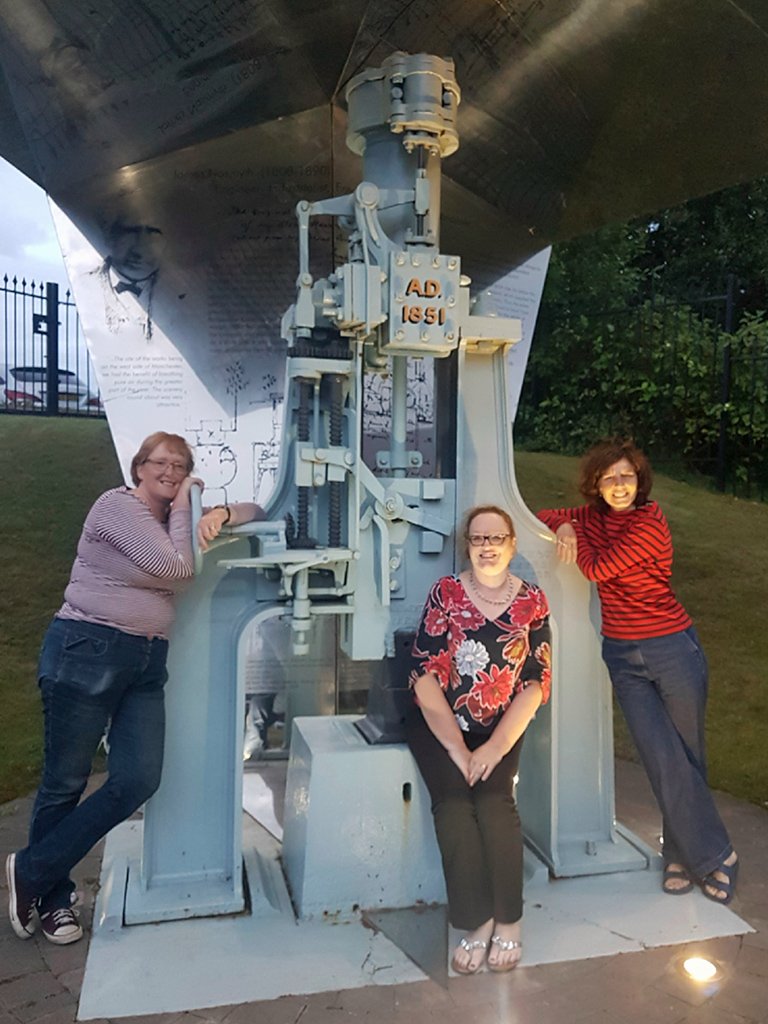
Many a local in Salford will walk or drive past Nasmyth’s Business Park on Green Lane, Patricroft and may glance with interest at the structure now surrounded by mirrored panelling at the entrance, but few will know how important it was to the Industrial Revolution.

The site was home to James Nasmyth’s Bridgewater Foundry in the 19th Century, making machinery, locomotives and tools. Standing proudly outfront with a fresh lick of light blue paint, is one of Nasmyth’s finest inventions, the steam hammer.

James Nasmyth chose Salford as the spot for his new engineering works after walking the route of the Liverpool and Manchester Railway in 1830. He stopped for a break at the point where the railway crosses the Bridgewater Canal and the site obviously made an impression on him. When he had to move from his premises above a glass works in Dale Street (because some machinery fell through the floor!), he moved to the Patricroft site.

The steam hammer design was an innovation for metal work, as before its conception metal hammers struck every blow with the same amount of force. The steam hammer could be controlled to gently break the top of an egg placed in a wine glass or fall with such force that the vibrations could be felt for miles. A party trick often displayed for the Earl of Ellesmere and his guests.

The hammer was developed initially for Isambard Kingdom Brunel in order to make steam ships and was sold across the world transforming manufacturing. It was quickly adapted and used in pile driving. Bridges such as the High Bridge in Newcastle and The Royal Border Bridge in Berwick upon Tweed were built much more quickly than ever possible before due to the speed and efficiency of the pile driver. Piles which previously would have taken men 12 hrs to install now took minutes.

The Steam Hammer on Green Lane was in use in Elsecar Colliery in Barnsley. It is one of the smallest of the hammers that was available. Others could reach 20ft tall and could deliver blows of over 100 tons. As part of the EST 1761 project to revitalise the Bridgewater Canal funding and local enthusiasts brought it to Salford for renovation.

James Nasmyth was originally born in Scotland but spent much of his life in the Industrial heartlands of England.

If you would like to hear more about James Nasmyth, the steam hammer and the Bridgewater Canal in Salford why not check out our series of walks around the area.

Michele is a Green Badge Guide for the Bridgewater Canal

Contact her directly to discuss a tour:

Call: 0778692053

Email: gotguided@gmail.com

http://www.facebook.com/gotguided

Bridgewater Canal Guided Tours

Are you a Gongoozler?

Canals are a natural tourist destination. Are you a Gongoozler? For centuries a Gongoozler has been someone who comes down to watch the goings on along the canal.

We Salford Bridgewater Canal Green Badge Guides all love to gongoozle! This is not a new phenomenon and has been happening since canals were first developed and especially the Bridgewater canal begun in 1761.

Early tourism had sent the nations young men out on the Grand Tour to see and experience new things in Europe and Frances Egerton, later the 3rd Duke of Bridgewater was no exception. The canals of Europe had a lasting effect on him.

When he developed his canal in Worsley, he wished that it should be as much use as it is ornament.

In the 18thC people were looking for something different to visit. Industrialists were travelling to see new inventions and techniques, visiting new ironworks and mills springing up across the country.

For ordinary people the lives in the new industrial cities were a wonder after an agricultural subsistence.

In 1851 Queen Victoria visited Worsley and officially put the Bridgewater Canal on the tourist map.

After WW2 the canals were in decline and at risk of being lost but still retained their charm.

The canals needed protection so the Inland Waterways Association was formed 1948 and the British Waterways Board in 1963. As Minister for Transport, Barbara Castle pushed through the Transport Act of 1968 in which the leisure value of canals was officially recognised.

Today with the Bridgewater Canal is a wonderful place to visit and there is a wealth of history in every spot along its length. The Bridgewater Way regeneration project has provided paths and info boards alongside the canal through Salford and will eventually connect a 39mile/65km leisure route for walkers and cyclists.

Why not visit the Delph, newly regenerated with interpretation boards and art works or stop in to one of Worsley’s café’s or bars for refreshments on route.

Bridgewater Canal Guided Tours
Est 1761

Est.1761

The Bridgewater Canal in Salford

In early February 2014, Salford City Council secured funding from the Heritage Lottery Fund, Peel Holdings and other partner organisations to revitalise the Bridgewater Canal in Salford.

A walk along the banks of the canal is a journey to the past and a glimpse into the future. Every stretch of the waterway has a story to tell us about human ingenuity, endurance and events that shaped both Salford and the world. This is a place of global importance, inspired by the vision of three men and the toil of hundreds of nameless heroes.

Est.1761 project contributed towards the ongoing transformation of the Bridgewater Canal in Salford. Developing it into a waterway that is once again a genuine focus for local, regional and national communities. The canal now has improved towpaths, information panels and rejuvenated parks. The foundations of Brindley’s original stone aqueduct from 1761 have been uncovered for all to see.

The canal’s historic starting point at Worsley Delph is now a visitor attraction with interpretation boards and sculpture befitting of its significance in the industrial revolution.

Visit: http://www.est1761.org/